ODM Fragrance Development: Six Mistakes First-Time Founders Make
Most ODM projects do not fail on the production line; they fail in the brief. When a founder sends a mood board and a target price, the manufacturer fills every undeclared gap with its own defaults — a base accord it already compounds, a standard bottle, a fill size that suits its line — and each default quietly moves a decision from the brand to the supplier. The six mistakes below recur on first ODM projects, and all of them are cheap to correct before development starts and expensive to correct after tooling.
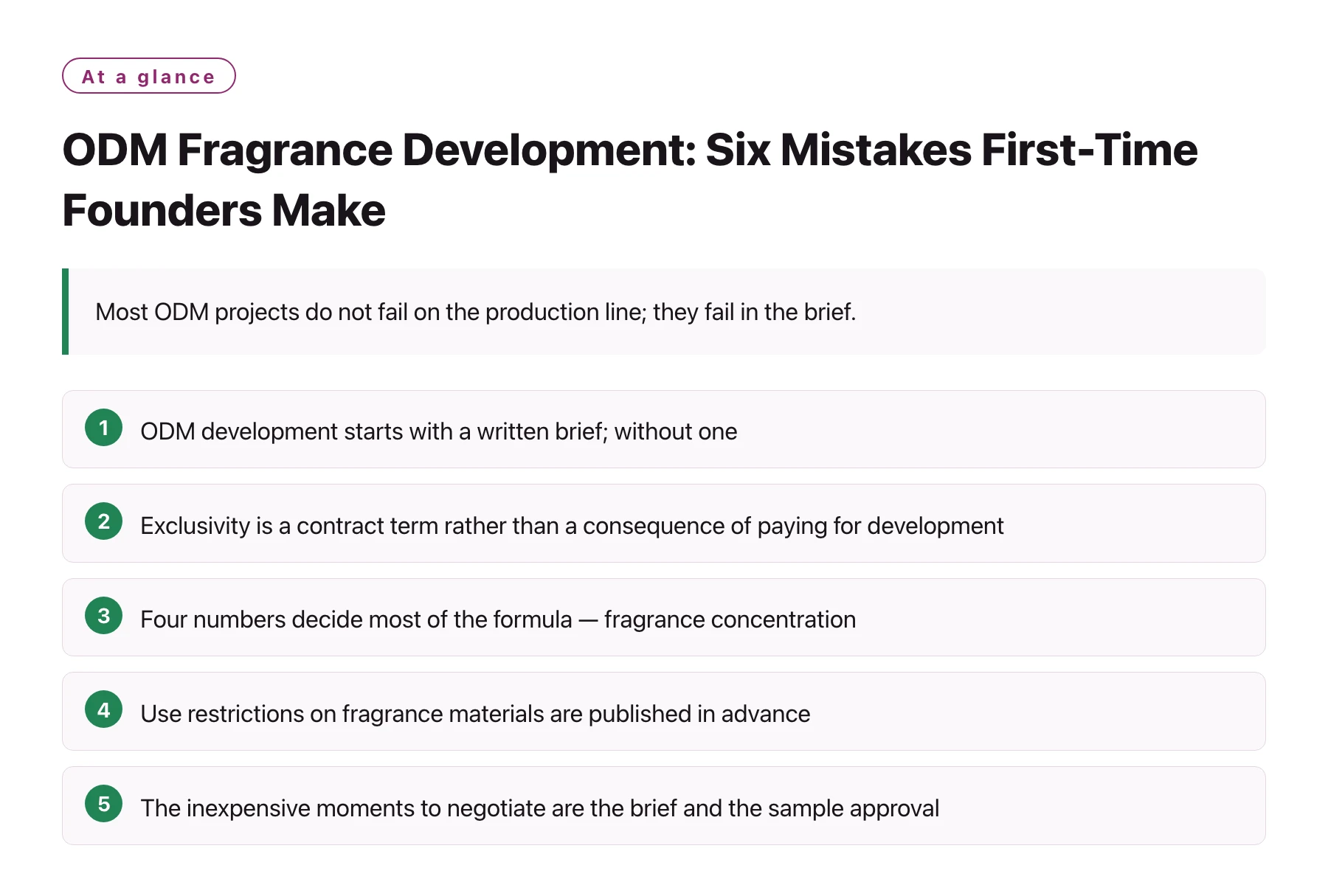
Key takeaways
- ODM development starts with a written brief; without one, the manufacturer makes every undeclared decision for you, and those defaults become your product.
- Exclusivity is a contract term rather than a consequence of paying for development, so a base accord built around your brief can legitimately be offered to another brand unless the agreement says otherwise.
- Four numbers decide most of the formula — fragrance concentration, target unit cost, fill volume and destination market — and changing any of them after sampling usually means restarting development.
- Use restrictions on fragrance materials are published in advance, so a brief that ignores them can send an otherwise workable concept into a reformulation cycle [1].
- The inexpensive moments to negotiate are the brief and the sample approval; the expensive moment is the first bulk order, once moulds, labels and cartons have been committed.
A first ODM project usually begins with enthusiasm and a folder of screenshots. The brand knows the mood it wants — warm, clean, expensive-looking — and assumes the factory will translate that mood into a product. Translation is exactly what ODM does, and that is both its appeal and its risk.
In ODM the manufacturer develops the scent from a brief and reuses bases, bottles and pack formats it already has. The brand gets a shorter path to a first sample and a lower entry cost; in exchange it accepts that the starting point is not bespoke unless exclusivity is purchased. None of that is a problem as long as both sides know it.
The failure pattern is consistent. The brand leaves decisions implicit, the supplier chooses sensibly, and the first bulk order arrives as a product nobody quite specified. Working through the six mistakes below before development begins is the cheapest insurance available at this stage.
Where an ODM project is really decided
Development is not one long conversation; it is a short sequence of narrowing choices. What should the scent do, what may it cost, how is it packaged, and where will it be sold. Each choice removes options, and the earlier ones are the hardest to reverse. A written brief fixes those early choices, which is why a supplier can price a complete brief quickly and can only guess at a mood board.
The commercial shape of ODM also has to be understood before the first invoice. The manufacturer is not only selling production capacity; it is selling access to development work it has already paid for. That is what makes ODM economical, and it is also why the defaults it supplies are shared rather than private.
It also helps to know early whether the supplier is a single operation or a coordinator of several. A a factory that handles fragrance R&D and production on its own floor answers scope questions differently from a trading company that buys each step in, and that difference shows up later in lead times and in how easily a change can be absorbed.
The four numbers that shape a formula
Fragrance concentration, target unit cost, fill volume and destination market do most of the work. Concentration decides how much concentrate goes into each bottle and therefore the largest single line in the cost. Target unit cost sets a ceiling on raw materials. Fill volume changes packaging, transport and, in some markets, duty. Destination market decides which materials are permitted and which documents are required.
Safety limits are the number founders most often discover late. The IFRA Standards publish maximum use levels for a long list of materials, and a concept that leans heavily on a restricted material has to be rebalanced rather than simply turned down [1]. It is far cheaper to meet that constraint while the brief is still a document than after a sample has been approved and photographed.
Exclusivity means whatever the contract says
Paying for development does not by itself buy exclusivity. In a standard ODM arrangement the manufacturer owns the base it develops unless the agreement transfers ownership or grants exclusivity, and a base that is not exclusive can be sold to another brand, sometimes in another market. That is not a hidden trick; it is the commercial logic that makes ODM inexpensive in the first place.
If exclusivity matters — and for a brand whose scent is its differentiator it usually does — say so in the brief, in writing, and expect it to change the price. ODM is a reasonable home for a brand testing a category or a price point. It is a poor home for a brand whose entire positioning rests on a scent it does not own.
Six mistakes and what they actually cost
| Mistake | Why it happens | What it costs later |
|---|---|---|
| Briefing by mood board | References communicate a feeling, not constraints | The factory supplies defaults you never chose |
| Assuming exclusivity comes with development | Development feels like a purchase | The same accord can reappear under another label |
| Chasing a price before a specification | Price is the easiest question to ask | Quotes cover different scopes and cannot be compared |
| Ignoring use restrictions | They live in technical documents, not mood boards | Reformulation after sampling resets the schedule |
| Approving a sample from a photograph | Photographs are fast and feel decisive | Disputes at bulk stage with no retained reference |
| Leaving packaging until the end | The scent feels like the hard part | Bottle, cap and carton lead times gate the launch |
Read the second and fourth rows first. Both are invisible at the quotation stage and both are expensive to discover later, which is why they belong in the brief rather than in a post-mortem.
A brief is not a long document. One page covering concentration, unit cost ceiling, fill volume, destination market, exclusivity position and the packaging route is enough to price the project and to hold both sides to the same understanding. If a supplier cannot work from that page, the problem is rarely the page.
Writing a brief a factory can price
The practical test of a brief is whether two manufacturers would quote the same scope from it. If one quotes a 50 ml spray and another quotes a 30 ml dabber, the brief was ambiguous about packaging, and the lower number is not a better price — it is a different product.
Describe the scent in behaviour, not adjectives
Words like fresh or luxurious mean different things to different noses. It helps to describe behaviour instead: how strong should it be on first spray, how long should it last on skin, what should remain after an hour, and which three existing products are the closest reference. A factory that develops scents for a living can work with that far faster than with a mood board, and it can push back early if the brief asks for effects that are expensive to achieve.
Ask for the scope in house
Choose the partner before the price. A ODM fragrance manufacturer with its own compounding, filling and packaging lines usually absorbs a mid-project change more gracefully than an intermediary that subcontracts each step, simply because the change does not have to travel between companies. The useful comparison question is not who is largest but who can describe in one list which steps happen on their own floor.
Treat paperwork as part of the product
Documentation deserves the same attention as the formula. Ingredient disclosure, labelling and market registration differ by destination, and a supplier that ships to your region routinely will answer from habit rather than from research [2]. That routine is part of what a brand buys, and it is much easier to assess before the contract than during the first shipment.
The two-week version of getting this right
Week one is writing: one page on the four numbers, one paragraph on exclusivity, one list of packaging components. Week two is testing the page against three suppliers, asking each to restate the scope in their own words before quoting. The supplier whose restatement matches your intent most closely is usually the better partner, even if the number is not the lowest.
Spend an hour on the exit as well. If the relationship ended after two years, could you reproduce the product elsewhere? If the answer is no, the missing piece is a clause — formula ownership, retained reference samples, artwork and mould files — and every one of those is still cheap to add the checks that matter before signing a contract.
Keep the approved sample boring
A reference sample should be sealed, dated, labelled with its batch and formula reference, and held by both parties. Approval based on a photograph or a memory of a meeting is not a reference standard, and the gap between the two becomes visible only when a bulk batch smells slightly different and neither side can prove what was agreed.
Sources
- IFRA Standards Library (International Fragrance Association) —— The IFRA Standards Library lists the restrictions the fragrance industry applies to individual fragrance ingredients, based on safety assessments; it is the reference point for compliant fragrance formulation.
- European Commission: Cosmetics in the EU —— The European Commission's overview of EU cosmetics rules, including the responsible person, product information file and safety report requirements.
Frequently asked questions
Does ODM mean the factory owns my formula?
In a standard ODM arrangement, yes. The manufacturer develops the base and retains it unless the agreement transfers ownership or grants exclusivity. That is why the ownership clause belongs in the brief, before development is billed, rather than in a conversation after the first order.
How long does ODM development take?
Plan for a sequence rather than a single date: brief, first sample, one or two revision rounds, approval, then packaging. The scent stage is often faster than founders expect, while bottle and carton lead times are usually the part that decides whether a launch date holds.
Can I ask for exclusivity later?
You can ask at any time, but it is priced at the moment you ask, and by then the base may already be in another brand's range. Negotiating exclusivity alongside the original brief keeps the leverage on your side of the table.
What should I send with an ODM brief?
A written description of how the scent should behave, two or three benchmark products, the four numbers, the destination market and a packaging direction. Photographs are useful as illustration but should never be the only specification.
How do I compare two ODM quotes fairly?
Send an identical written brief and ask both suppliers to restate the scope before quoting. If the restatements differ, the quotes are not comparable, and the difference tells you which parts of your brief are still ambiguous.