Risk Review: Comparing machinery quotations and inclusions
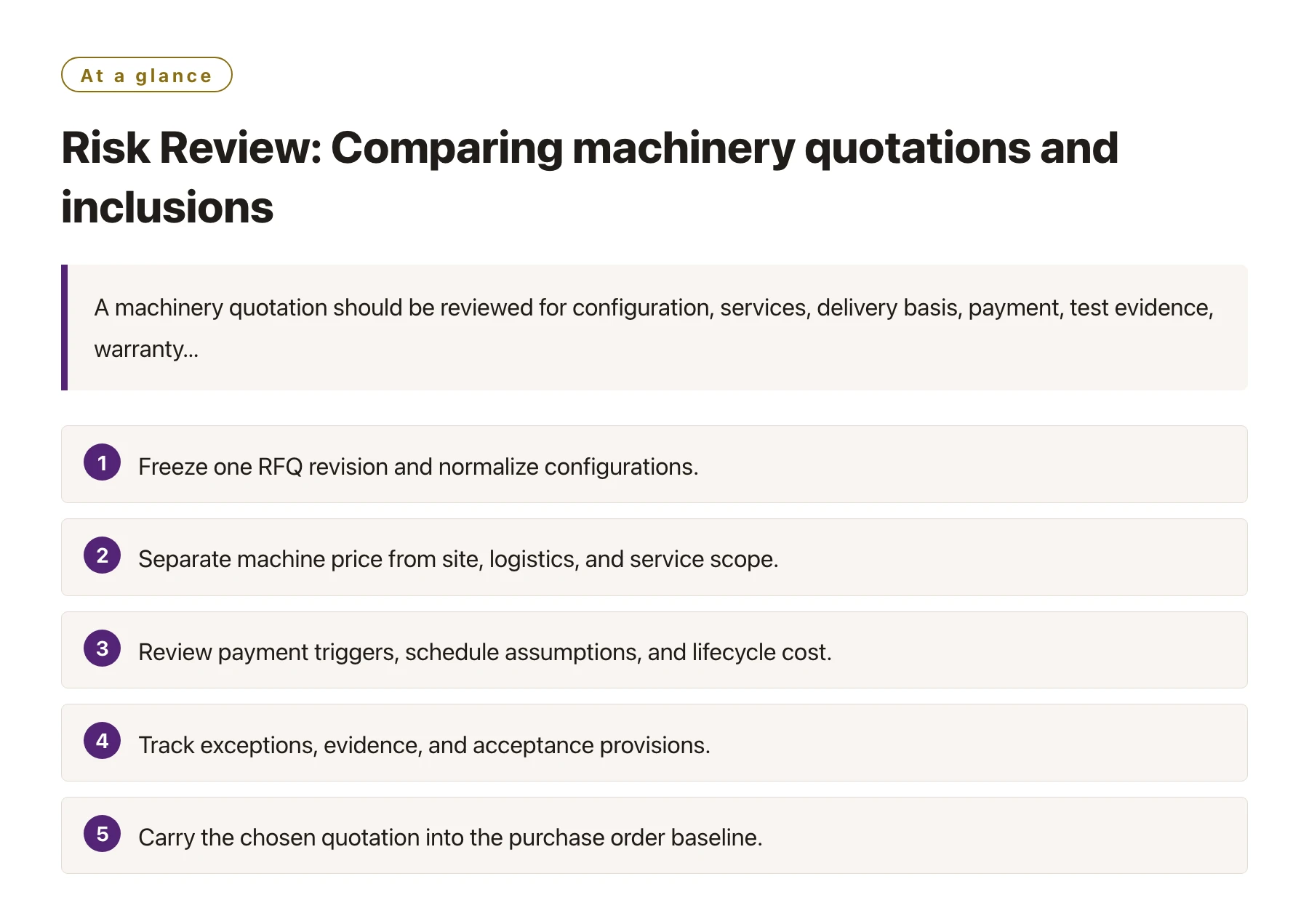
A machinery quotation should be reviewed for configuration, services, delivery basis, payment, test evidence, warranty, and exceptions. The buyer can then compare total exposure using the same technical and commercial baseline.
Key takeaways
- Freeze one RFQ revision and normalize configurations.
- Separate machine price from site, logistics, and service scope.
- Review payment triggers, schedule assumptions, and lifecycle cost.
- Track exceptions, evidence, and acceptance provisions.
- Carry the chosen quotation into the purchase order baseline.
Quote review is a risk-control step. It reveals which assumptions, omissions, and decisions could affect the machine after award.
1. Confirm the technical baseline before comparing
A machinery quotation comparison can mislead when offers respond to different requirements. Freeze the RFQ revision, operating conditions, output, accuracy, material, utilities, controls, safety expectations, and required documents. List mandatory values and permitted alternatives separately. Ask each supplier to confirm deviations line by line.
Tie every offer to a machine model, configuration, drawing revision, options, and accessories. A sales description or photograph is not enough to establish that two machines are technically equivalent. Identify who will approve technical evidence and who may accept a change.
2. Identify configuration gaps
Compare base machine, motors, controllers, tooling, fixtures, guards, sensors, software, accessories, and spare parts. Record make, model, quantity, and whether each item is standard, optional, substituted, or excluded. Different controls or tooling may change performance, serviceability, and operator training needs.
Check installation and site prerequisites: foundation, electrical supply, air, extraction, network, lifting, and access. Ask which party provides each. A supplier may quote the equipment while expecting the buyer to procure components or prepare facilities that another bidder included.
3. Separate delivery scope from installation work
Break out packing, export preparation, inland haulage, freight, insurance, unloading, storage, installation, commissioning, training, and site acceptance. Define the duration and location of each service. Clarify what utilities, local technicians, lifting equipment, production materials, and permits are the buyer’s responsibility.
The ICC Incoterms rules allocate specified seller and buyer responsibilities, costs, and risks. State the rule, version, and named location in the quote and contract, then review transaction-specific obligations with a qualified trade professional. A delivery term should not be treated as an all-inclusive installation or customs package. [1]
4. Examine price structure and payment exposure
Compare equipment, engineering, tooling, sample, test, documentation, packing, service, and spare-part charges as separate lines. Record currency, validity period, minimum quantity, taxes or duties excluded, bank fees, and price-adjustment clauses. Ask how exchange-rate changes or component substitution affect a firm order.
Review deposits and milestone payments against objective deliverables such as design approval, assembly completion, documented test, or shipment release. Define what evidence triggers payment and how conditional work is handled. A milestone named “ready” should say who confirms readiness and which records prove it.
5. Check lead time and capacity assumptions
Separate design, long-lead components, fabrication, assembly, software, testing, packing, and dispatch. Ask what event starts the lead-time clock and whether the date assumes timely drawing approval, deposit, or buyer-furnished materials. Compare the schedule with recent comparable orders and available test capacity.
Identify schedule buffers, shutdown periods, outsourced processes, and supplier dependencies. Ask what happens if a component is delayed or a test fails. A short lead time may be achievable, but the offer should explain the resources and assumptions behind it.
6. Compare warranty and lifecycle costs
Normalize warranty start date, duration, covered parts and labor, exclusions, response route, replacement time, travel, and freight. Ask how remote diagnostics, training refreshers, software updates, and site service are priced. Confirm where service parts are stocked and which components have long lead times.
Estimate maintenance, consumables, recommended spares, energy, licensing, and operator training where data is available. A machine with a low purchase price may cost more to operate if it depends on unavailable parts or specialized service. Keep lifecycle assumptions distinct from confirmed supplier commitments.
7. Review evidence and acceptance provisions
Ask for a requirement-response matrix linking each claim to drawings, test reports, data sheets, sample runs, or references. Confirm the evidence applies to the offered model and configuration. Distinguish supplier declarations from witnessed or independent test results.
Define factory and site acceptance tests before award: test conditions, sample material, duration, measures, tolerance, instruments, witnesses, issue handling, and retest. State how open findings affect shipment, payment, and final acceptance. Avoid resolving a failed test through an unpriced verbal promise.
8. Record exceptions and commercial risk
Maintain an exception register with requirement, supplier response, evidence, price impact, schedule impact, owner, and status. Separate accepted, pending, rejected, and not offered items. If a response is silent, keep it open rather than treating silence as compliance.
Assess risk across performance, delivery, service, warranty, and change control. Use mandatory pass/fail gates for critical requirements, then score preferences. Run sensitivity checks for freight, currency, installation, and spares if they could change the ranking.
9. Reconcile supplier terms before award
Check quotation validity, payment clauses, liability limits, cancellation, governing terms, warranty, documentation, spare parts, and dispute route. Compare the supplier’s terms with the purchase order and contract. Identify which document controls if clauses conflict and seek appropriate legal review for material exposure.
Ensure all options, accepted deviations, and excluded services are reflected in the final revision. Remove superseded quotes from the approval pack or clearly mark them obsolete. Keep a dated decision note that explains why the selected offer best fits the project.
10. Convert the chosen quote into an order baseline
Attach the accepted configuration, drawings, exception list, acceptance plan, delivery basis, payment milestones, and warranty terms to the purchase order. Name who can approve technical changes, price changes, or shipment release. Require written notice before substitution of major components, software, factory, or subcontractor.
Buyers reviewing industrial equipment sourcing support can use a structured risk comparison to align technical scope, cost, testing, and delivery assumptions. Confirm the final supplier acknowledgment against the approved offer before authorizing production.
Sources
Frequently asked questions
What is the biggest risk when comparing machinery quotations?
Offers may price different configurations, services, delivery responsibilities, or acceptance terms despite similar headline totals.
Should installation always be included in the machine price?
Not necessarily, but the quote should state installation scope, buyer prerequisites, travel, commissioning, training, and excluded site work.
How should I compare machinery lead times?
Compare the start trigger, component dependencies, design and test stages, capacity evidence, and schedule buffers.
What belongs in an exception register?
Record each unmet or unclear requirement, supplier explanation, evidence, cost and schedule effect, owner, and final disposition.