Budgeting a Small Farm Around Two Fee Rates
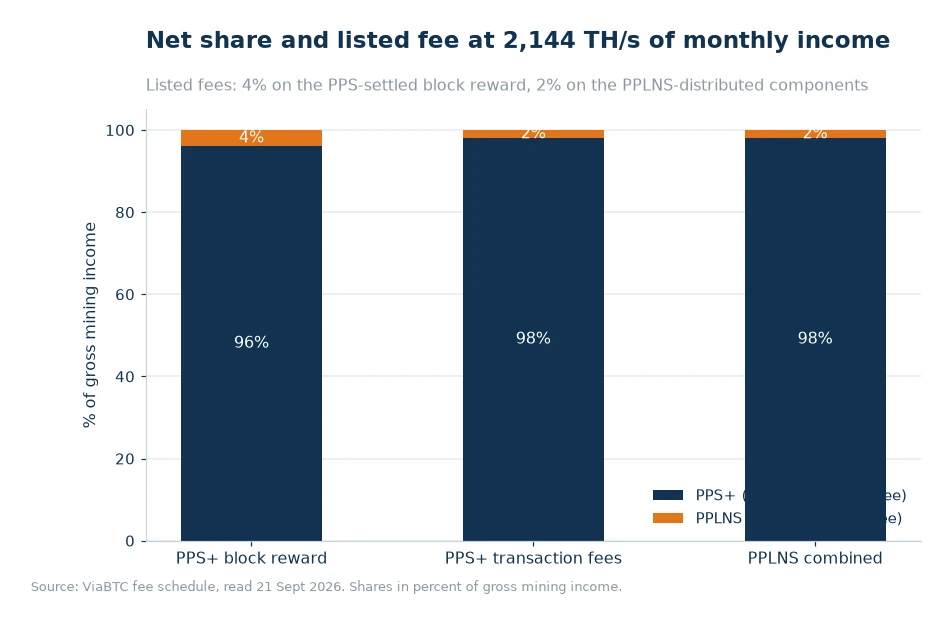
My power bill arrives once a month and my mining credit arrives every hour, which is why the two never quite line up in my head. At 2,144 TH/s the gross is $81.46 a day; the listed 4% on the block-reward component is $3.26, and the listed 2% on the PPLNS-distributed components is $1.63. Everything below is an attempt to hold those three figures steady for a whole billing cycle.

Key takeaways
- A 30-day month at 2,144 TH/s grosses $2,443.80 and nets $2,346.05 after the listed 4% line.
- The listed 2% on PPLNS-distributed components is a separate line, not a discount on the first one.
- A ten percent reserve on net income covers about three days of a 2% difficulty swing without touching savings.
- PPS+ pays hourly, which suits monthly bills; PPLNS pays later and in lumps, which suits a reserve.
The bill arrives in one currency, the rates do not
Four things land on my desk each month: the power invoice, the hosting invoice for two machines I do not keep at home, the pool credit, and the bank statement that shows what I actually converted. Only the third is a mining number. The other three are accounting, and the fee schedule sits between them like a tax table that nobody enjoys reading.
What changed my budgeting was refusing to blend the rates. PPS+ is the default, and it charges a listed 4% on the block-reward component while the transaction-fee component follows PPLNS logic at a listed 2%. When I first saw those figures I multiplied the gross by 6% and built a whole month's plan on it. The plan was wrong by a small but real margin, and the error repeated twelve times a year.
Building the monthly envelope
Start with a daily gross at the hashrate the machines actually deliver, not the nameplate figure. Mine is 2,144 TH/s across seven units, measured at the pool rather than read off a sticker. That gives $81.46 a day at $84,692 per BTC. The 4% line is $3.26, and the 2% line is $1.63, which leaves $78.20 to spend on power, hosting and the occasional fan.
The envelope then needs a shape. I use three columns: what the pool will pay, what the utilities will take, and what stays. The third column is smaller than most new operators expect, and it is the one that has to survive a bad week. If the third column is negative before power is even counted, no fee schedule can rescue the site.
Before trusting any of those columns, read the ViaBTC Pool Fees page and copy the two rates into the sheet with the date you read them. Everything downstream depends on that pair being current.
Thirty, thirty-one, ninety
Month length matters more than it should, so I keep a small calendar table rather than a single monthly figure. The numbers below use the same daily rate and apply the listed 4% line to the full gross as a planning approximation.
| Period | Days | Gross | Listed fee | Net | Reserve |
|---|---|---|---|---|---|
| February, non-leap | 28 | $2,280.88 | $91.24 | $2,189.64 | $218.96 |
| Standard month | 30 | $2,443.80 | $97.75 | $2,346.05 | $234.60 |
| Quarter | 90 | $7,331.40 | $293.26 | $7,038.14 | $703.81 |
February is the row that taught me to stop budgeting on 30 days. Two fewer days is $162.92 of gross, which is roughly the cost of a replacement PSU and a day of a technician's time. Small farms feel that. Large ones round it away.
When the difficulty estimate turns negative
The estimate on 21 Sept 2026 pointed to a 2.12% difficulty reduction at the next adjustment. For a miner that is a small raise: the same hashrate earns slightly more coin because the network is asking for less work per block. I do not put it in the base case, because an estimate is a direction rather than a promise, but I do note it beside the envelope.
What matters for budgeting is the direction of the trend, not the next print. Difficulty has moved against miners for most of the last decade, with interruptions. A plan that assumes every adjustment is favourable is not a plan; it is a hope with a spreadsheet around it. My base case holds output flat, and any reduction becomes reserve rather than spending money.
Sizing the buffer for a two percent swing
Two percent of $2,346.05 is $46.92 a month. That sounds trivial until it compounds across a quarter and lands in the same week as a failed control board. My rule is a reserve equal to ten percent of net, which is $234.60 at this hashrate, or about three days of full gross. It does not cover a catastrophe. It covers the ordinary friction of running hardware in a shed.
The reserve also absorbs settlement timing. PPLNS credits arrive after six confirmations, so a run of slow blocks can push a payment past a bill date even when the coins are already earned on paper. A reserve turns that from a cash problem into a scheduling note, which is the correct size for it.
Keeping one number honest across coin choices
I run BTC on this account and nothing else, which keeps the envelope simple. Friends who split hashrate across several coins have a harder time, because each chain has its own difficulty and price, and a blended daily figure hides both. If you do split, build one envelope per coin and add the totals at the end rather than averaging the rates.
The Profit Calculator is the tool I use to rebuild the envelope when the price moves more than a few percent, and the multi-currency wallet keeps the converted proceeds in the same account as the mining credit, which saves a transfer step at month end. Neither changes the arithmetic. They just make it faster to redo.
Worked example
Here is the full month on paper, using the same 2,144 TH/s figure the chart uses.
- Network share: 2,144,000 GH/s ÷ 1,003,107,267,295 = 0.00000213736.
- Daily coins: 0.00000213736 × 450 = 0.00096181 BTC.
- Gross dollars: 0.00096181 × 84,692 = $81.46.
- Listed 4% line: 81.46 × 0.04 = $3.26 a day.
- Listed 2% line on the PPLNS-distributed components: 81.46 × 0.02 = $1.63 a day.
- Net after the 4% line: 81.46 − 3.26 = $78.20 a day, and 78.20 × 30 = $2,346.00 for a standard month.
- Reserve at ten percent: 2,346.00 × 0.10 = $234.60, left in the account rather than converted.
Note which line I did not subtract. The 2% applies to the transaction-fee component under PPS+, not to the whole gross, so subtracting both would double-count the planning allowance. I keep the 2% visible in the table because it matters on months when fee revenue is large, and I keep it out of the base subtraction because most months it is not.
Frequently asked questions
Should the reserve come out before or after the fee?
After. The listed fee is deducted by the pool, so the reserve should be a share of what actually reaches the account: at 2,144 TH/s that is $78.20 a day, and ten percent of the monthly total is $234.60.
Does a 31-day month break the envelope?
It adds $81.46 of gross and $3.26 of listed fee, so the net rises by about $78.20; the envelope holds as long as the power and hosting lines are also counted per day rather than per month.
Why keep PPLNS in the plan at all?
Because the transaction-fee component inside PPS+ runs on PPLNS logic, so the six-confirmation timing can still delay part of the credit even when the default mode is selected.
Set the envelope before the next cycle
Write the daily gross, the two listed lines and the reserve into one sheet, then date it. Mine carries 21 Sept 2026 and gets rebuilt whenever BTC moves enough to change the first digit of the daily figure. The published rate page is where the percentages come from, and checking it is the first thing I do before signing anything that lasts longer than a month.
Sources: the fee schedule, calculator and wallet pages at viabtc.com. On 21 Sept 2026 the network stood at 1,003 EH/s, each block carried a 3.125 BTC subsidy at 144 blocks a day, and BTC changed hands near $84,692[1]. Envelope rows assume the machines run non-stop. Published 24 Oct 2026.