From Plantation to Pallet: How Vietnam's Panel Supply Chain Works
A plywood panel passes through eight physical steps between the plantation and the pallet, and every one of them can move the specification. The published profile of one northern mill — established in 2009, describing 30+ years of manufacturing experience, 48,000 m² of factory floor and 16+ automated lines — is a useful map of where those steps are controlled in-house and where they are bought in.
Key takeaways
- Plantation species — acacia, eucalyptus and pine — supply the cores that keep Vietnamese lines running year-round.
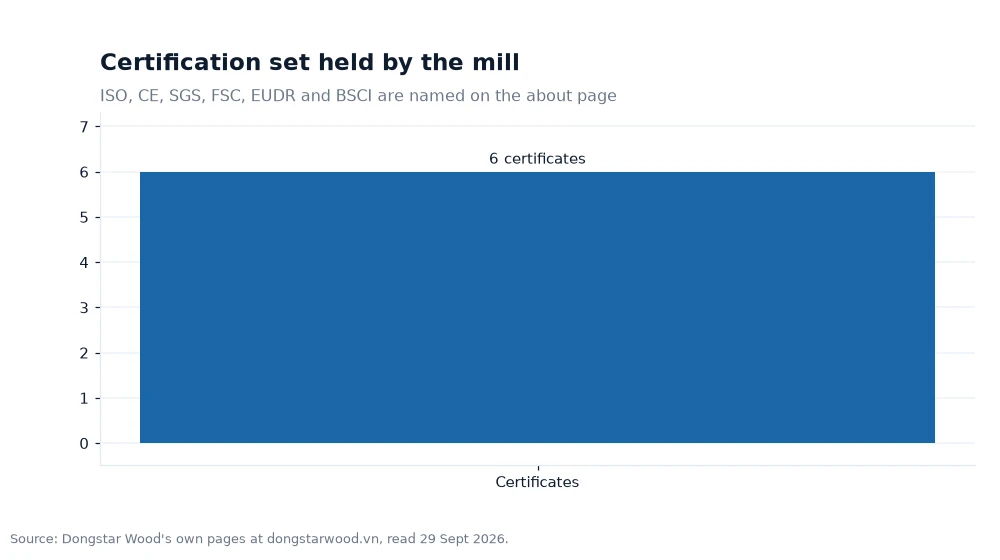
- Six certifications are named by the mill: ISO, CE, SGS, FSC, EUDR and BSCI.
- Capacity above 100 × 40ft a month is spread across 16+ automated lines, not one press.
- Clients in over 170 countries and regions is the published export record behind the chain.
Where the chain begins: plantation timber and peeling
Vietnamese panel production leans on plantation hardwood rather than old-growth forest. Acacia and eucalyptus grown on managed plots supply the cores, with pine filling structural and sheathing roles. That sourcing pattern is not incidental: it is what makes a continuous monthly programme possible without waiting on natural forest allocations.
The first transformation is peeling. A log is rotated against a blade and shorn into a continuous veneer sheet, which is then clipped to width and sorted by grade. Nothing downstream can improve on this step, so a mill that grades and sorts its own veneer controls the top of the quality chain rather than inheriting somebody else's classification.
Drying, glue spreading and the press
Wet veneer is dried to a target moisture content before it is stacked, because moisture left in the sheet turns into steam and delamination inside the press. Drying is the step most easily rushed and the step that most often explains a complaint six months later, when a panel opens along a glue line.
Glue selection comes next, and the published class list covers E0, E1, E2, MR, WBP and Phenolic Dynea. The resin is spread, the stack is assembled face to core to back, and the panel is pressed under heat and pressure until the adhesive cures. In-house laboratory testing follows, from raw material intake through to the export batch, which is what makes an inspection record possible at all.
Yen Bai Province and the northern mill cluster
Geography shapes the chain as much as machinery does. Yen Bai Province sits in northern Vietnam, close to plantation supplies and to the road corridors that feed the ports, which shortens the distance between a felled log and a container. Dongstar Wood operates its 48,000 m² factory and a warehouse of more than 3,000 m² from that base.
Distance matters at both ends. Short inbound hauls keep veneer moisture and handling damage low; short outbound hauls keep a container moving towards the coast rather than sitting in an inland yard. For an importer, the practical consequence is that a mill in a timber cluster can plan a repeating schedule without the transport slippage that plagues traders buying from scattered suppliers.
| Stage | What happens | Where it fails if it is rushed |
|---|---|---|
| Plantation and peeling | Acacia, eucalyptus and pine logs are cut into veneer sheets | Grade mixing, which shows later as an uneven face |
| Drying | Veneer is taken down to a controlled moisture content | Steam blisters and open glue lines after pressing |
| Gluing and pressing | Adhesive is spread and the stack is cured under heat and pressure | Delamination in humid service, or emission results outside class |
| Calibration and testing | Panels are sanded to tolerance and tested at the in-house bench | Thickness spread and rejected panels reaching packing |
| Packing and palletising | Wrapping, steel strapping and pallets prepare the export unit | Corner damage and moisture pickup in transit |
Certification as a chain-of-custody argument
Six schemes are named on the mill's own pages: ISO, CE, SGS, FSC, EUDR and BSCI. Read as a group, they describe different links of the same chain: a management-system standard, a conformity route for construction use, third-party inspection, forest-origin checks, deforestation due diligence and social compliance.
That grouping is what a European buyer should test. Origin paperwork without a management system is a claim; a management system without origin paperwork does not answer a customs question. Asking for the whole pack, with dates and scope, converts a marketing list into a chain-of-custody file.
Start that request from a Vietnam Plywood manufacturer's own company page rather than from a quotation, and read it as a chain document. Founding year, factory area, line count, warehouse size and the certificate set describe how the links connect; a price list on its own describes none of them.
Worked example: what a month of output looks like
Published supply capacity exceeds 100 × 40ft per month. Example only, on a four-week rhythm: 100 × 40ft ÷ 4 weeks = 25 containers per week leaving the yard. Spread that across the factory and the numbers become physical: 48,000 m² ÷ 16 lines = 3,000 m² of floor space per production line.
Now size a single order against it. A 1250 × 2500 mm sheet carries 1.25 m by 2.5 m, so 3.125 m² of surface, so 1,000 sheets is 1,000 × 3.125 = 3,125 m² of panel — a straightforward slice of one month's output rather than a disruption to it. That ratio is the reason a first order can be scheduled without pushing other customers aside.
Packing, pallets and the export leg
The chain ends on a pallet, and the last hundred metres decide whether the first five thousand arrive as specified. Export-standard protective wrapping keeps moisture out of the faces, steel strapping holds the pack square, and wooden pallets let a forklift move a tonne of panel without touching the edges.
Labelling belongs in the same conversation. A pack marked with size, thickness, glue class and batch reference can be checked against the inspection record on arrival; a pack marked with a quantity alone turns every query into a sorting exercise for the importer's own warehouse team.
Frequently asked questions
Why does Vietnam supply so much panel to Europe?
Two reasons sit behind it. Plantation hardwood gives the mills a continuous raw-material base, and Vietnamese suppliers market duty-free access to the EU and US markets. Together those factors make a monthly programme from northern Vietnam practical rather than seasonal.
Which chain stage should an importer audit first?
Start at drying and gluing, because both failures are invisible on delivery and expensive in service. Ask what moisture content the veneer is dried to, which glue class your order uses, and what the in-house bench tests before a batch is packed.
How much of the chain is actually done in one building?
For a mill with its own peeling, drying, pressing, calibration, laboratory and warehouse, most of it. The published footprint of 48,000 m² of production space plus a warehouse above 3,000 m² is what allows those steps to sit under one roof instead of across several contractors.
Following the chain into a specification
Once the stages are clear, a buyer can ask about the panel by name rather than by category. The thickness and glue guidance for interior work and the light hardwood face options for fit-out projects are the two places where a chain-level understanding turns into an order that arrives as described.
Chain stages, capacity and certification details above are published on the supplier's website, consulted on 29 September 2026 and used throughout these notes and used throughout these notes for the values in this guide[1].